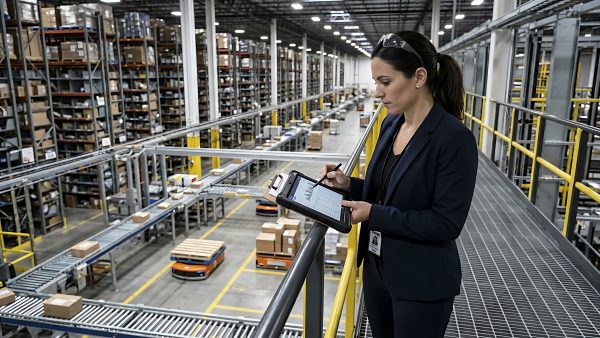
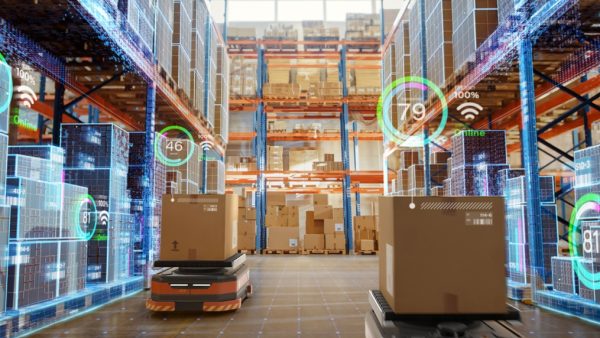
This blog is an overview of the presentation “Scaling Up: Automation and Work Platforms in Action” given live at MODEX 2026. HERE is a link to the audio of that presentation.
Scaling Up: Building the Foundation for Smarter Warehouse Automation
As warehouse operations continue to evolve, businesses are under pressure to improve productivity, maximize available space, and respond to changing customer demands. For many organizations, success depends on more than adding automation. It requires creating the infrastructure and facility design needed to support automation both today and in the future.
The combination of automation, elevated work platforms, and strategic facility planning is helping companies increase storage density and operational efficiency. As robotic technology advances, organizations are taking a more holistic approach to design facilities that can adapt and grow alongside their operations.
Think Beyond Square Footage
For years, warehouse capacity has been measured primarily by available floor space. Today, leading operations are focused on maximizing cubic volume.
By utilizing vertical space through elevated platforms and multi-level work areas, facilities can create additional capacity for storage, picking, sorting, maintenance, and other critical functions. Whether retrofitting an existing building or designing a new operation, building upward can unlock significant efficiencies without requiring facility expansion.
Start with Scalability in Mind
Successful automation projects are designed not only to meet today’s needs but also to support future growth. Many organizations begin with targeted solutions that address immediate operational challenges and then expand those systems over time as demand increases.
Planning for scalability from the outset can make it easier to add storage, increase throughput, or incorporate additional robotics without major disruption. It is also important to understand how automation will interact with the facility itself. Mobile and stationary systems each have unique design, safety, and structural requirements that should be evaluated early in the planning process.
Automation Is Becoming More Sophisticated
The first wave of automation largely focused on reducing travel time by moving products closer to workers. Today’s technology is increasingly focused on reducing manual intervention at the point of work itself.
Robotic picking technologies continue to advance, enabling greater accuracy, consistency, and productivity. At the same time, emerging technologies are expanding the capabilities of automation systems beyond simple transportation tasks, creating opportunities for more comprehensive automation throughout the fulfillment process.
As these technologies continue to mature, businesses will have more opportunities to automate repetitive tasks while improving consistency and productivity.
Infrastructure Matters More Than Ever
While automation systems often receive the most attention, underlying infrastructure plays an equally important role in project success.
Mobile robotic systems place unique demands on floors, platforms, and building structures. Factors such as floor flatness, surface conditions, load capacity, and traffic patterns can directly affect performance and equipment longevity.
For facilities considering automation, a thorough evaluation of existing infrastructure should be one of the first steps in the planning process. Understanding structural capabilities early can help avoid costly modifications later and ensure systems are designed for the environment in which they will operate.
Safety Must Be Designed In
As automation deployment increases, safety remains a critical consideration.
Today’s robotic systems incorporate sophisticated software controls, obstacle detection technologies, and traffic management systems designed to safely navigate complex environments. Physical safeguards such as fencing, guarding, and designated operating zones help separate personnel from automated equipment when appropriate.
The most effective safety strategies combine technology, facility design, and operational processes to create environments where automation and employees can work safely together.
Environmental Conditions Cannot Be Overlooked
Warehouse environments vary significantly, and automation systems must be designed accordingly. Temperature fluctuations, moisture, lighting conditions, floor materials, and electrostatic discharge (ESD) requirements can all influence system performance. Cold storage and freezer applications introduce additional challenges related to battery performance, condensation, and sensor reliability.
Understanding these environmental factors early in the planning process helps ensure equipment selection in the facility design align with operational realities.
Collaboration Drives Better Outcomes
Perhaps the most important lesson for organizations pursuing automation is the value of involving the right stakeholders early.
Successful projects often begin with collaboration among facility owners, automation providers, structural engineers, platform designers, and material handling experts. When infrastructure and building design are planned alongside material handling equipment requirements, organizations are better positioned to achieve long-term operational success.
Automation continues to evolve at a rapid pace, creating new opportunities to improve efficiency, capacity, and productivity. As companies evaluate their next investment, those that take a holistic approach, considering technology, infrastructure, and future scalability together, will be best equipped to maximize the benefits of automation while preparing their facilities for the demands of tomorrow.
Again, if you would like to listen the live presentation, here is the link: https://dfxhkgozl2wkt.cloudfront.net/mx2026/SMA_160_Apr15.mp4